Good news everyone! The maintenance goal of our crowdfunding campaign is 100% funded. Huge thanks to everyone who supported us! Our focus now moves to the first stretch goal: €25k to co‑design federated groups together with communities.
Whether you are an old‑school tweeter or have moved to the fediverse, you know the status quo: follow people, read your home feed, boost, reply, and maybe gather followers, post thoughts or links and receive random replies. That can be great for conversation and discovery, but the moment you try to organise something together, like an event, project, reading circle or local initiative, you feel the limits of a feed built around individuals.
Shouting at the mythical "global town square" may be fine for chatter but it’s lousy for organising. When you need specific people to see, act, and follow through, you need a group. So your community's calls to action aren't at the mercy of algorithms or noisy feeds.
Federated groups in Bonfire will be spaces where communities gather to organise, care, and coordinate across the fediverse. They'll live next to your personal feed, but each group having a specific purpose: a study circle, a lab team, an activist collective, a local mutual aid crew, a project team. Inside you’ll find posts, conversations, calendars, shared resources, and more. Crucially, groups will be portable and interoperable (see FAQ), so communities can grow and thrive without lock‑in.
How this compares with groups on existing platforms #
Millions of people rely on Facebook groups and other Big Tech platforms to connect and communicate, but enshitification and overnight, top‑down changes keep communities locked in and powerless.
Bonfire’s federated groups restore agency: a shared home to gather and organise without the traps. Communities own their spaces, set visibility and membership on their terms, and members can join and participate from anywhere, without platform or server lock‑in.
See the FAQ) for details about portability, interop, or how groups compare to forums and “threadiverse” apps.
What groups bring to the table #
Imagine a repair cafe with a calendar, community documents like code of conduct and how‑tos, a shared resource list, and discussions that carry on between meetups so planning and organising keep moving. Or a research collective that shares articles, schedules peer sessions, and keeps notes in one place. Or an activist movement that coordinates across servers without forcing everyone to “move” to a single app.
Groups make these everyday needs feel natural, not improvised. They sit alongside your main feed, giving communities a home where real collaboration happens rather than getting lost in the noise.
Pilot communities and real use cases #
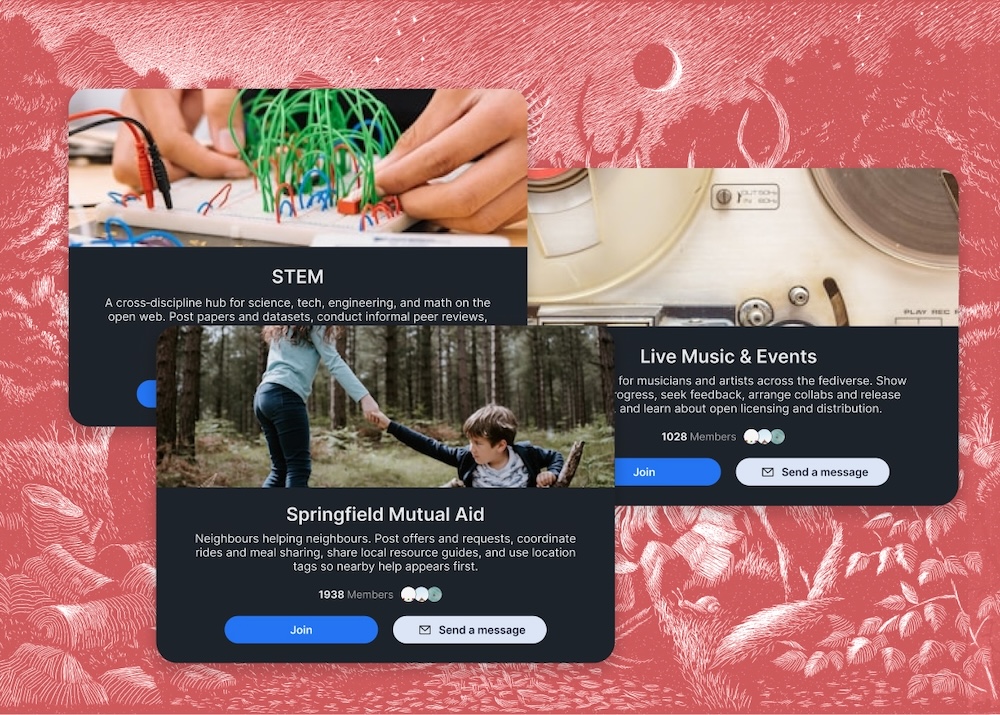
Federated groups are not just a concept. We are co‑designing them with communities who have lived these needs and who will help design how they should work in practice. Partners like Princeton HCI and pilot communities make the use cases concrete. They help us design groups that work for real people, not simplistic features designed for the lowest common denominator.
Gifting groups #
Gifting communities (such as BuyNothing groups on Facebook) show how everyday care can flourish when neighbors build trust and simply offer, request, and match what's needed. Group admins like Adrian and Lee from Gifting with Integrity explain how in such groups:
"enthusiasm and passion gets passed through friends and friends-of-friends like a wave [and] is just not comparable to receiving a link from a stranger. If people know and trust the admins, this trust is also transferred into the group they create. This becomes an essential part of setting and propagating the culture. Everyone in the group is connected to everyone else, friends, family or neighbours and this affects how we interact with each other: with accountability and consideration (not like many other spaces of the internet, which are more like people who have crossed international borders to go on a bender without repercussions)..."
Having run large local groups and watched Facebook’s enshitification increasingly degrade their experience, they now want to rebuild autonomous spaces. In Bonfire, gifting groups will rebuild trust, share offers and needs, and design location‑aware features that prioritise nearby neighbors, so generosity moves sustainably through neighborhoods.
Mutual Aid Networks #
From everyday support to emergencies, mutual aid such as HUMANs coordinate people, information, food, rides, spaces, schedules, funds, and other resources locally. Today, much of this lives inside closed platforms, spreadsheets, or siloed tools that are hard to search and share.
Federated groups can provide mutual aid networks a portable home across the fediverse, with location‑aware activities, resource lists, and simple matching mechanisms that prioritise local or urgent needs.
Knowledge Commons & Open Science Network #
Knowledge Commons is a network for researchers and knowledge creators across disciplines, where they can discover open‑access scholarship and teaching materials, share work in the repository, and make interdisciplinary connections. Communities building on Bonfire's Open Science Network flavour, such as Sciety also curate and discuss preprints, reviews, and scholarship across institutions. Until now, these groups typically live inside single sites where membership and conversations are siloed, and participation can be cumbersome.
With federated groups, research and knowledge‑sharing collectives can span institutions and disciplines, keeping conversations, documents, and events portable so coordination doesn’t break when people, servers, or platforms change.
Civic coordination #
As Jon Pincus, member of the Washington Privacy Organizers said:
"Group functionality comes up in almost every single conversation I have with organizers and activists about their needs. Microblogging is great for getting the word out about actions and other kinds of public communications, but isn't useful for other important scenarios like discussing priorities and tactics or working in cross-organization coalitions."
Activist groups and civic technologists have worked on participatory processes and community coordination for years, and need portable spaces that cross organisational boundaries, with clear roles, shared context, and the ability to keep discussions and decisions visible over time.
What's next #
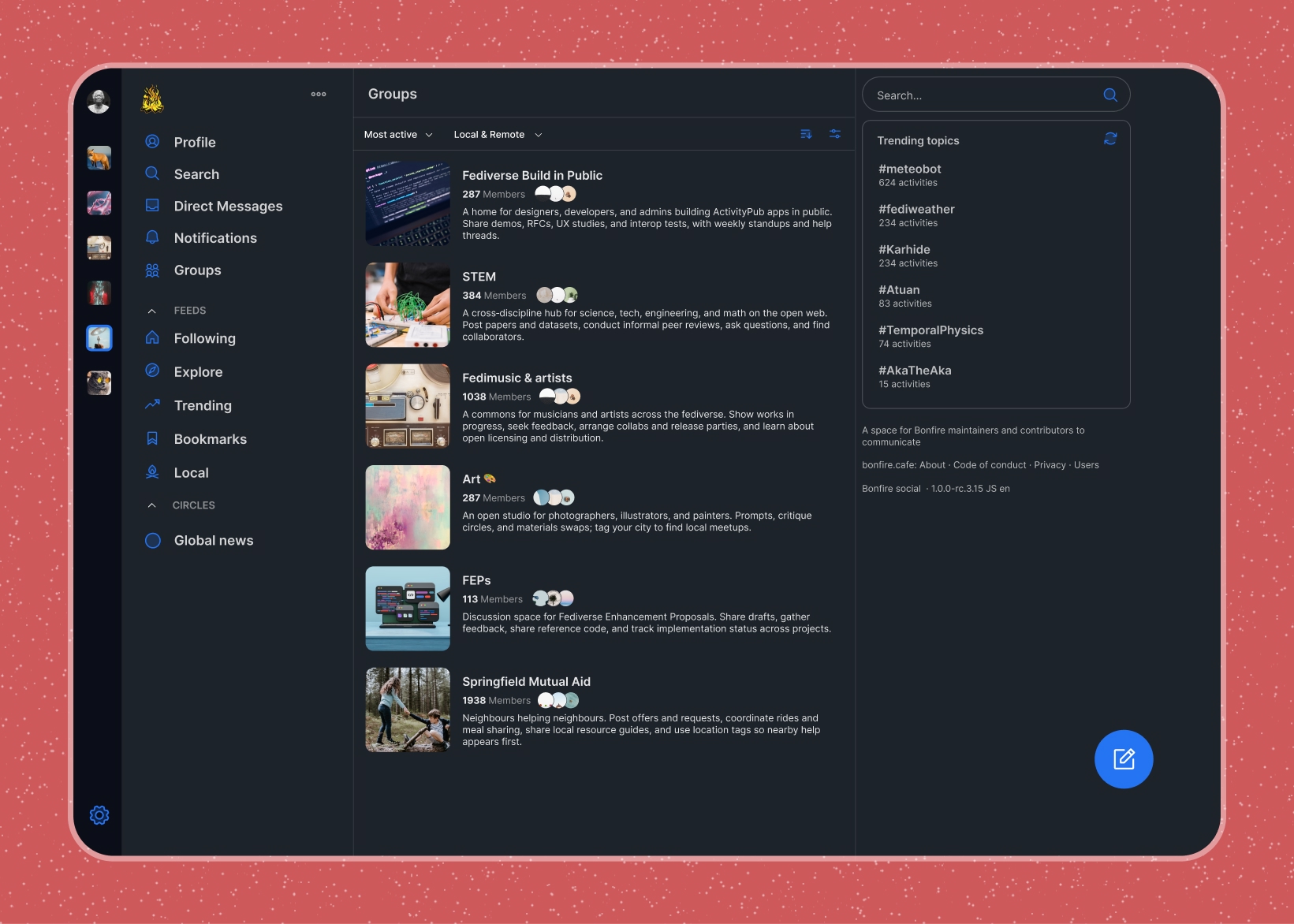
We’ve prototyped the core groups functionality; next we’ll build the tools communities need, co‑designing the UX with partner communities, learning from pilots and iterating in the open, to ensure groups federate across Bonfire instances and compatible fediverse apps.
Our north star is maximum compatibility: we’ll align with standards and collaborate across the ecosystem, while keeping usability and real workflows front and centre so people and groups can safely interconnect across servers and platforms. For details on portability and interop, see the FAQ).
We need your help #
If this resonates, please back the groups stretch goal so we can deliver federated groups, bring your community into the co‑design process or join as a pilot group, and share the campaign with your networks.
Together we can give communities durable homes that cross server boundaries while staying open and portable, without trading away autonomy for convenience, so communities can organise, document, and coordinate in spaces they control. Let’s build the tools communities deserve, and let's make them community‑owned from the start.
FAQ (Frequently Asked Questions) #
Will this work with Mastodon? #
To begin with, Mastodon users should be able to interact with federated groups at a basic level. Group posts and replies will appear as standard activities to Mastodon users, and they'll be able to follow and @‑mention groups. Some specific features may not be supported in Mastodon and will appear as links back to the group’s home server.
What about old‑fashioned forums? #
Forums are excellent for structured, long‑form discussion. Threads nest neatly, topics stay organised, and communities build rich archives over time. They’re also often self‑hosted, governed and moderated by their community rather than at the whims of a Big Tech platform. But classic forums are typically isolated on a single site. You need to create a new account for each one and remember check for updates regularly (or endure noisy email notifications). If you move on, you lose the network, content, and reputation you built there, as forums rarely interconnect with each other or the wider social web.
Groups in Bonfire are inspired by the best of forums (community-run with clear topics and findable archives) while being portable and interconnected across the fediverse from the start. A group is not only a set of threads; it also has rules (who can find it and join, who can post or participate, who can see what's posted, and codes of conduct and moderation processes), a list of members and moderators, and content such as events, shared resources, and other lightweight workflows living in one context, so organising feels natural. You have a single identity on your home server from which you can join and participate in groups on any server, rather than being stuck on a single site.
We should note that Discourse modernised the forum experience with cleaner UX and solid organisational tools and has an experimental federation plugin to enable forums to exchange some activity. NodeBB is a similarly modern forum app that has implemented federation and integrates with the fediverse. These are important steps we support and want to interconnect with.
How this compares to the "threadiverse"? #
Reddit and the federated platforms it inspired (such as Lemmy, PieFed, and Mbin) are great for topic‑based discussion. Bonfire groups overlap with some of those ideas and aim to be compatible with the threadiverse, but with experience is more focused on collaboration than just topical threads and votes. Think less “top tech news of the day” or “comment storm on a hot post” and more “a space where an idea or project unfolds over time.” You can plan a meetup, share notes, link documents, and keep decisions visible.
A key detail for longer discussions: Bonfire supports deeply nested threaded conversations with a design inspired by those apps. When a topic branches in different directions, replies can split into focused sub‑threads, making it easier to follow each path without losing the larger context. Long conversations become more readable, and side topics can mature without derailing the main thread.
What do you mean by portable and interoperable groups? #
Portable: Your identity stays on your home server, but you can join groups anywhere. Groups can move hosts and take their membership and existing content with them.
Interoperable: A group on one server can talk to people and groups using other apps or servers. Posts, replies, events, and updates travel across the network without forcing everyone onto the same platform. And because groups sit inside the wider fediverse, a conversation can bridge to Mastodon, threadiverse apps, federated forums, or any other ActivityPub platforms without losing the group’s home or history.
What standards will this use? #
We build on ActivityPub and ActivityStreams 2.0. For group‑specific behaviour, we'll use and contribute to Fediverse Enhancement Proposals (FEPs) and participate in the SWICG working group.
We will endeavour to avoid fragmentation between different implementations:
- Participate in shared standards work (FEPs, SWICG, etc)
- Publish an interoperability guide and docs
- Provide reference JSON examples and test fixtures
- Prefer the most compatible common behaviours; add clearly defined extensions that degrade gracefully
How do moderation and safety work across instances? #
All the familiar moderation tools are available: report, block, or (de)federate at the server group, or individual level. Groups also will have their own moderation team which can for example remove/hide posts, which federates to other servers to reduce duplicated labour.