What is it?
Bonfire is open-source software for running your own community on the open social web, the network of independent servers that Mastodon, Bluesky and others are part of.
For museums, we connect it to the collection you already publish, so the art itself becomes part of the open social web, not only your institution's news. Your design, your rules, your data.
Where museums are today
Every museum holds an enormous amount of knowledge: artworks, artists, exhibitions, research, the stories behind each object. Almost all of it lives on collection pages that are not part of the open social web. People can look at them, but they can't follow them, talk about them or share them where they already spend their time.
Many museums have already joined the fediverse. But what joined is the institution's account, not its knowledge.
- The knowledge is buried. Thousands of works, artists and exhibitions sit in static pages people have to go and search for.
- The social account carries only a sliver of it. Posts scroll away. A reply about a painting never reaches the painting's page.
- The public can't follow what they love. Not an artist, not an exhibition, not a single work. Only the institution.
Bonfire bridges the two. It brings the knowledge your museum holds onto the open social web.
Open your collection to the open social web
Bonfire publishes your collection to the open social web, as much of it as you choose, within the boundaries you set. Each part becomes something people can follow, discuss, bookmark and reference, from any app.
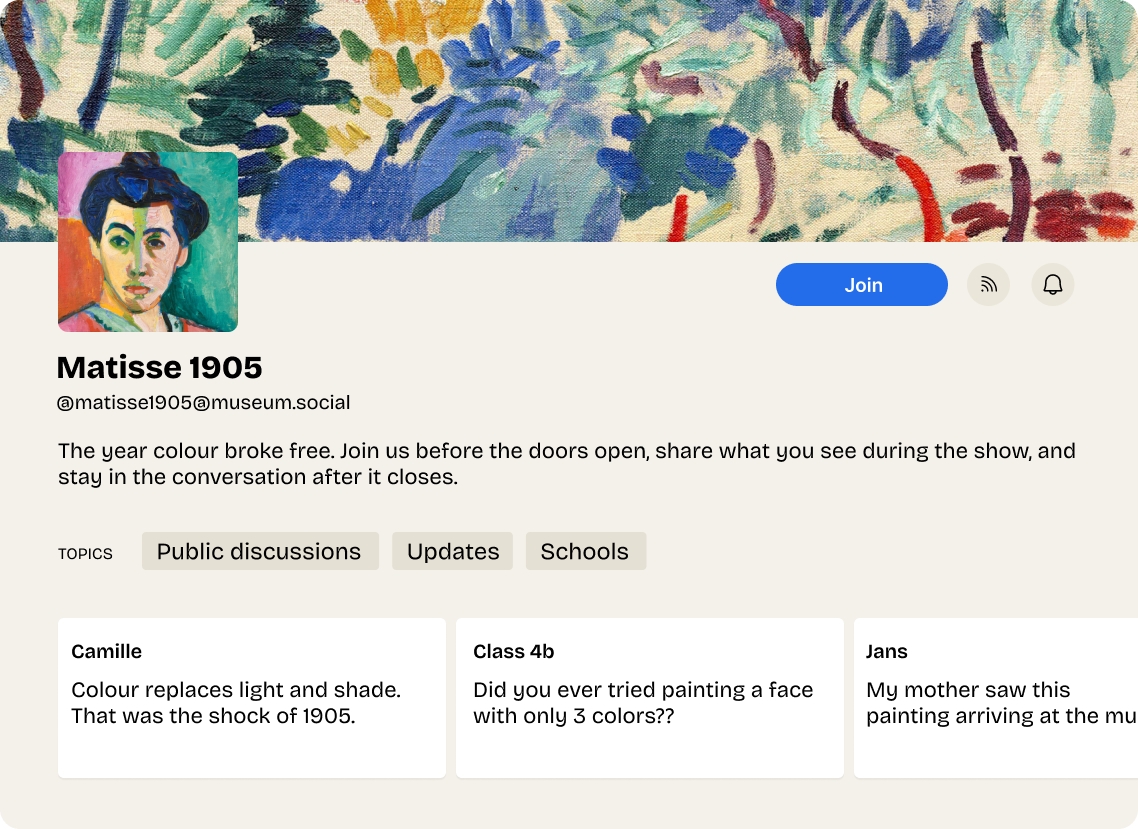
Every exhibition becomes a group
The exhibition stops being a few announcements and becomes a place people take part in. Inside it, conversations are organised by topic, so everyone finds their own way in, and anyone can simply follow the updates.
Inside "Matisse 1905", painters argue about colour in one topic while families swap tips for visiting with kids in another. A local school posts its students' own three-colour portraits next to the masterpieces. Others just follow Updates, and guided tours and late openings arrive in their feed.
Every artist becomes someone to follow
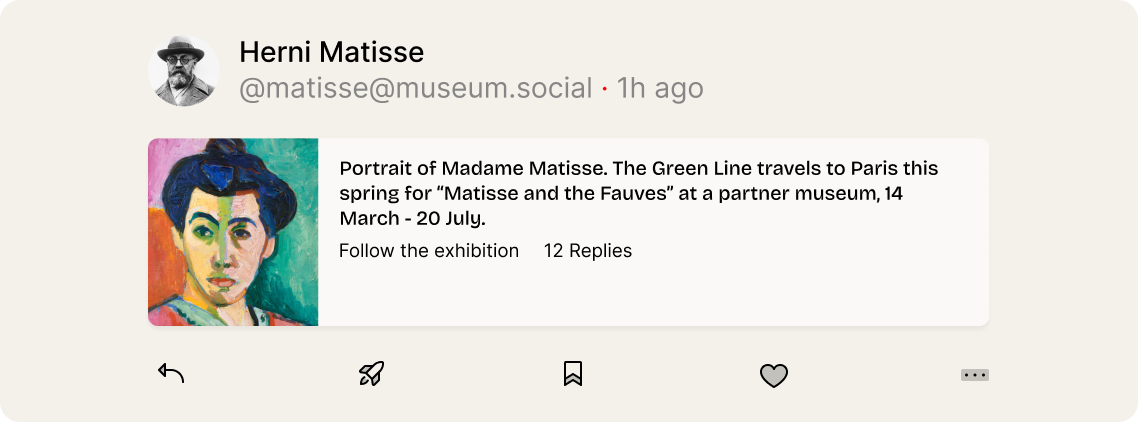
Fed by your collection, curated by your staff, followed from any social app. People who would never follow a museum will follow an artist they love.
A student in Lisbon has never visited your museum, but she follows Matisse. When The Green Stripe leaves on loan, she hears it before the press does. When it comes back, she books a ticket.
Every artwork becomes a conversation
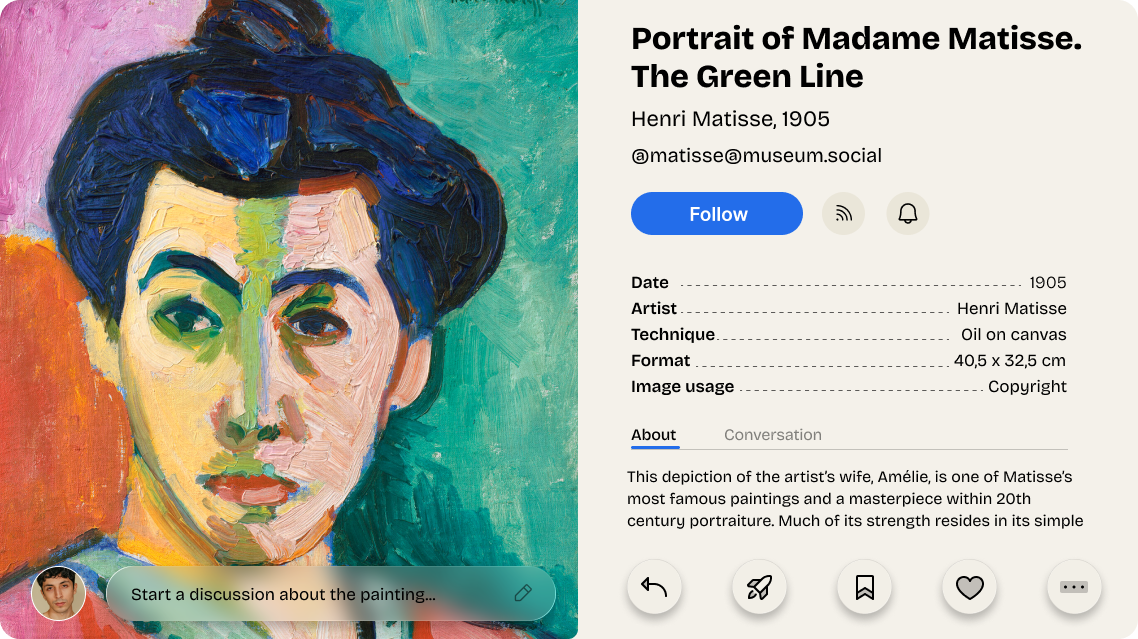
Each artwork page hosts a discussion that anyone can join, on your website or from their own social app. Every reply, from anywhere, lands under the work.
A visitor asks why the face in The Green Stripe is split by a green line. A Matisse scholar on another server answers from her own app. Her answer stays under the painting as well as travelling across the open social web, for every visitor who comes after.
You decide what opens, and to whom. Public-domain works can travel anywhere. Copyrighted images can stay on your own site. Research notes can open only to registered researchers, and a school's discussion only to its class. Your permissions travel with the data.
Beyond the microblog
A museum account on the open social web is a great start, but it only carries what the social media team has time to post. Everything else your museum knows, thousands of works, artists, exhibitions and years of research, stays on pages people rarely find. Bonfire gives that whole body of knowledge a new life on the open social web, and you decide what opens.
Only what the social media team posts is shared
Your whole collection can be shared, and you choose what opens
People follow the institution and get all its news
People follow an artist, an artwork or an exhibition, and the museum official account
Posts scroll away in a timeline
Conversations stay with the work, on your page, for as long as the work is there
Replies stay on other people's servers
Replies from anywhere appear under the artwork on your website
An exhibition is a few announcements
An exhibition is a group people join, with topics to discuss and updates to follow
The museum speaks, the public reacts
Curators host, and visitors, researchers and schools have multiple conversations about the work
Each museum broadcasts alone
Related works in different museums share one conversation
Your website already holds the knowledge. Bonfire gives it a social life.